Free template
What your team may and may not put into AI, in a policy you can adopt this week.
Written for UK service businesses of five to twenty people, based on the one we built for an accountancy practice.
What's inside
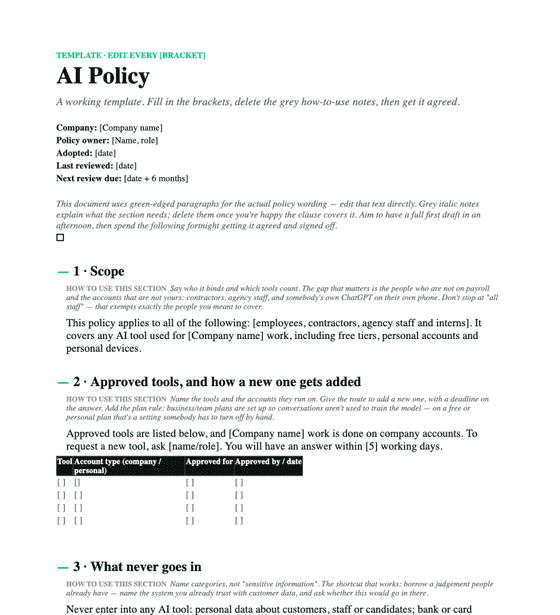
Eight sections, five pages, plain English.
- What may go into an AI tool, and what never does, with the one test that decides most cases
- The account and tool settings that decide where your data goes
- Who approves a new tool, and who owns the policy
- How often it gets reviewed, and what happens when something goes wrong
When you are ready, the next step is a fifteen-minute call.
This is a free AI policy template for UK service businesses: what staff may and may not put into AI tools, which settings to change, who decides, and how often it is reviewed. It was written by AI Edge, an AI training company in Reading, from the policy we built for an accountancy practice.
Three questions people ask first.
Not on a personal or free account, and only on a business account with the right settings. Free and personal plans can use what you type to train the model, so client information must never go into them. On a business plan, conversations are not used for training by default, which is why the policy says firm work is done on the firm's accounts and names which account each tool is approved on. Even then, the test the policy gives staff is whether the information would be safe to email to a stranger.
Yes, if you add them to the approved-tools table. The policy is written around a table of tools, the account each is used on, and what each is approved for, rather than around one product. Copilot, Gemini, meeting note-takers and browser extensions all go in the same table, and anything not in it is approved by the policy owner before first use.
Nearly. You need to fill in the approved-tools table with the tools and accounts your business actually uses, name the policy owner, and set the review date. The rest is written to be adopted as it stands: what may go in, what never does, how to check what comes back, disclosure to clients, and what happens when something goes wrong. Most businesses of five to twenty people can do that in an afternoon.